
As I’m juggling the myriad writing projects I’ve got simmering, the time frame on the most complex one (the follow up to the now out-of-print Modern Cellist’s Manual) stretches into the horizon. I suppose one advantage of being self-published is that I can bend theses deadlines around conditions on the ground as they evolve. It’s a double edged sword, though. One of my dearest friends writes music for film and tv, and I remember talking about the doldrums that tend to trap creative people when we’re working on something speculative, with no guaranteed audience or financial reward. He laughed and quipped, “To get this stuff done, you need two things: a paycheck and a deadline.” There is such truth in that! Especially for people like me, who are unaffiliated with an academic institution or a publisher. It’s possible to work really hard on a project only for it to arrive on the scene without so much as a muffled thud. It’s certainly happened before, and those memories act as a warning that lots of effort is not necessarily going to be appreciated by the cohort you intend it for.
This got me thinking about motivation in general, especially because I always have a few students who are lone practitioners: folks who either live in remote areas or don’t feel ready to participate in community music making. Without the prospect of an impending recital, rehearsal, or concert, it is a rare student who makes consistent progress without a stumble here or there. I sympathize! For the moment, I live in a relatively remote area, and gigs I do not create myself are incredibly rare. I still make progress because with each passing day, I am more besotted with the entire thing. I love the practice, the sound, the problem solving, the discipline, the smell of wood, rosin, and old paper, the tactile stuff, the memories, the years of callus that make manicurists want to reach for something sharp. I’ve even come to love extensions and Popper Nº9. I still don’t love the Boccherini concerto. I get to dislike one of the major works. Those are the rules.
A certain kind of person sticks with a musical instrument over the course of decades. It takes real determination because there are pressures from all directions encouraging you to stop, to second guess yourself, to feel terrible about the whole affair. For adult amateurs, it’s especally brutal. The crueler part of society laughs at adult learners. Classical music in particular scoffs. (I was told I started too late. I played piano at 4 and started cello at age 8. Ancient, indeed.) Stringed instruments are harder to get mediocre at than most other choices—although French horn and double reeds are at least as difficult to find a foothold with. Hat tip to them, truly. Let’s see, what else? If you’re a woman, there’s a chance your family will question or resent time spent doing anything not in service to them. If you’re a man, depending on the culture you come from, you might be called girly for taking art seriously. Of course what we do is expensive, so the financial pressure is there unless you’re very lucky. Last, there is the downside to internet sprawl: you are as likely to feel devastated by what you see online as you are to gain inspiration from it. I resonate with this SO MUCH. I used to feel threatened by Juilliard kids whizzing through the Arpeggione as if it was Suzuki 1. In the end, while we are in the same field, we are not playing the same game. For the cost of an easy Arpeggione, I got to play hockey. Learned about viticulture and enology. Took writers’ seminars and later taught writing at a community college. Toured with bands. Ran a nonprofit. Took flight lessons. And I can still work on the Arpeggione! I’m okay with the way this bargain turned out.
It’s the same with wherever you are and the people whose wonderful playing hurts you. You want to have things in common with them, like technique, expression, and confidence. But the application of those qualities are pointed in a different—but no less meaningful—direction. Your non musical life has immense value. Remember, people who volunteer to tear you down and diminish your efforts (including the meanie inside your mind) are simply telling you about themselves. Something about them takes offense at your efforts. I encourage you to DO IT MORE, LOUDER. These sour people and/or the unkind voice inside your head are not in charge of your life, and it’s not an accident that they frequently get loudest when your actions bring you closer to success. It’s good to work on neutralizing the inner critic, but as ever, actions speak louder than words. When you show up for yourself every day, even with a persistent internal naysayer, you make progress. I’ll talk about defusing the inner meanie in another post. For now, I invite you to focus on the things you love, the goals you pursue, the support of your instructor(s), and the practices you know nourish your relationship to music. Savor those things; chop wood and carry water, and do it again tomorrow.
Speaking of work, here’s an excerpt from the next book.
Exercise of the week: shifting
Requirements: comfort with tenor clef, familiarity with 3 octave scales
Before you play, it’s essential to parse out: what is the point of this thing? What is the composer trying to get me to do? In an étude, it’s not about the notes so much as how you manufacture them. What to demonstrate, what to guard against. I’ll reply in the comments, but I’d love to see what you come up with: what are the technical concepts involved? What is the ideal I’m looking for? I’ll give you the first one: shifts should be a release. The hand is soft and slightly open when moving these long distances. What else?
The finger pattern in blue continues throughout, even the last low Bb. Though weird, Bach loves asking us to put 2nd finger there, especially during double stops and movements that favor flats.
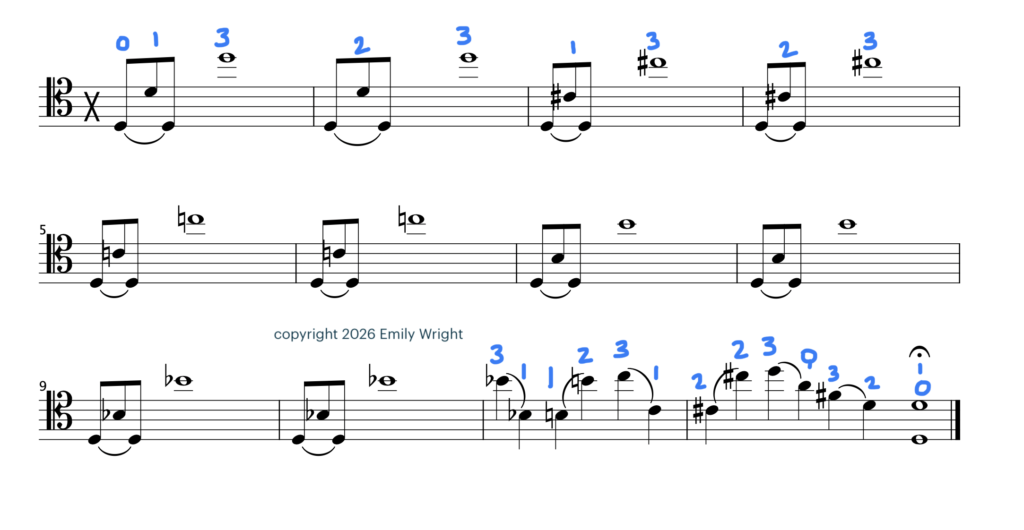
Here’s a link to the PDF if you’d like it on your tablet or want to print it out.
Variations to explore
- slur the entire measure
- slur 2, then single bows
- slur 2 and 2
- single bow 1st note then variations on slurring
- change up the rhythm: dotted is very useful, or make every note the same length and notice how that affects the experience
- use 1st finger as a guide
- old finger shifts
- new finger shifts
- old finger on the way up, new finger on the way down
- new finger on the way up, old finger on the way down
- take it super slow (actually harder!)
- take it at a brisk pace
- pretend it’s in bass clef and play these patterns on the D and G strings
- come up with your own (share in the comments, please!)
I’m still fighting with the paywall people, so the whole site is free until they get back to me. This post, including the étude, took 3 hours to create. If you’d like to tip your friendly neighborhood cellist, you can do so below. Thank you!
Two thoughts that came to mind while reading this. As someone who started cello as an adult (age 48) I have decided that I will no longer watch YouTube videos of the pieces I am learning if the player is (a) shorter than their instrument or (2) not yet old enough to drive. Yes, watching young phenoms show off is amazing, but it doesn’t help further my playing.
The second is a line from the movie “F1”, where Brad Pitt’s character tells someone, “Don’t be shitty to yourself, there are plenty of people who will do that for you.” Giving myself permission to struggle and stumble and feel like I’m stuck on a plateau forever is hard. I have to remind myself to not be shitty to myself.
That is excellent guidance. When I was studying voice, I had so much shame and discomfort to contend with; every note sounded like an apology. My instructor saw me sort of imploding during a lesson, and he said, a little sharply, “Be nice to her.” I asked “who?” “The woman who is trying very hard to improve her singing.” My eyes welled with tears. It had never dawned on me that I had a responsibility to be kind to myself in addition to all of the accountability and discipline. An aside about plateaus: you only reach them after a climb. As we advance, each climbing period takes longer and exposes us to more adversity along the way. A long time ago, I started describing these periods as safe harbor/sanctuary. A place to let everything sink in, to breathe and assess what the next hill will ask of me. Maybe I’m just too caught up with the semantics, but the reframing helped me punish myself a lot less.