
This piece originated as an assignment that sort of went rogue and proceeded to take over my life. It’s taken a long time—too long—to get it out into the world, but that’s a story for another day.
Today, I want to share a very different kind of post. While it’s certainly not the “here’s a deep dive on this technique” or “listen to this recording” you’re used to, it’s important to realize that, for many professionals, our musical lives are inseparable from the experiences we had—and continue to have—in the culture that surrounds us. When I write or give a workshop about stage presence, my body and mind are suffused with memories, both fond and shall we say, instructive. The teachers and colleagues who supported me are right there; present and taking up space, along the ones who went out of their way to maximize pressure and revel in my defeats. Other topics bring up their own contingent of characters: Brahms’ E minor Sonata will forever ring with Ron Leonard’s stern guidance on bow apportionment and my introduction to martelé. Haydn D major was my audition warhorse and has collected associations like black clothing picks up pet hair, among them, the time I played it for a former mentor and woke the next morning to a lengthy email about the things he’d like to do to me. I am fortunate that this and other experiences have not sapped my ability to enjoy music, though they have absolutely affected my career trajectory every bit as much as injuries and insider politics have.
All of this is to say that there is no way to truly separate the things we love about classical music from the things we do not. We can examine the disparate elements individually, but one cannot say they have a grasp of the way things work without acknowledging the entire mechanism. Fans of musicians, sports teams, film franchises often recoil when an incident of abuse/discrimination/other malfeasance comes to light. Comment sections overflow with “stick to sports, no need for this shit” and “I don’t care if he molested girls, this album slaps” and “I mean, women are just doing this to get back at him”. I don’t assume good faith on the part of most PeopleInTheComments™️. The internet teems with cowards whose only pleasure is making misery and smooth-brained edgelord cosplayers, not to mention the armies of bots. But for the handful of thoughtful people who resist facing up to the problems within the culture of your chosen passion, know this: your compliance is a necessity for the cycle to continue. Bad actors aren’t stupid. They’re awful people who explicitly understand they can count on folks like you to flinch more at the mention of abuse than the fact of the abuse itself. Abusers often hide behind charisma, professional networks, and the protection of the people they have not harmed. They’re very rarely the cartoon villains we would rather them be. That’s how it works. If there was an overwhelming sense that the general public would demand action and accountability following credible accusations of abuse, the entire landscape would change.
Lara St. John’s documentary is a treatise on one of the only quiet parts of a life in music: the pervasive silence surrounding the topic of sexual assault, harassment, and intimidation, especially when it comes to venerated instructors and the institutions that employ them.
My hope is that we can look back at this moment in a few years and appreciate the seismic shift in classical music culture that emerged as a consequence. If that happens, we will have Lara St. John and others like her to thank for it.
If you’d rather watch on YouTube, click here.
CW: non graphic discussion of sexual assault.
The Threshing Machine
The parable goes something like this: ten men are in a room, and one of them makes a vile joke at the expense of women. Two of the men laugh. Three chuckle a bit to fit in, though they don’t find it amusing. Four say nothing, pretending they did not hear it at all. Afterward, nine of the men believe they are the good guys, and that the one who made the joke is the exception.
The room is real. It’s a locker room, of course. It is also a staff lounge, a conference call, a cocktail party, a church vestry, a group chat, a political rally, a boardroom. These are spaces where currents of power intermingle seamlessly with depravity, where even a whiff of nonconformity can cost a career. Silence, after all, is golden.
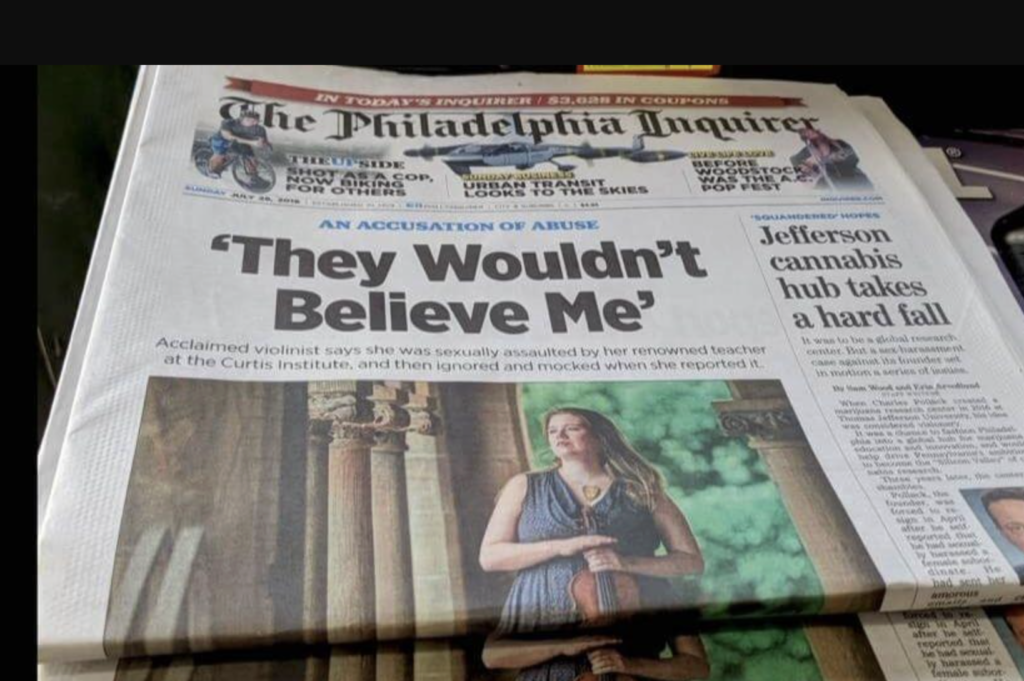
Violinist Lara St. John’s documentary filmmaking début is titled Dear Lara, which premiered at the Santa Barbara Film Festival earlier this year. Inspired by the overwhelming response to her public account of abuse in the Philadelphia Inquirer, it chronicles the devastating experiences she and others have been subject to at the hands of a trusted instructor—facilitated by a culture of institutional complicity that borders upon sadism.
Tacet
Dear Lara is beautiful, unflinching, and harrowing. Unadorned by any sense of overt production slickness, mechanics of abuse are laid bare: a filing cabinet drawer opened just enough to obscure a studio window. Lessons organized to occur off campus. A throat gripped tightly to muffle screams. St. John, whose rape by Jascha Brodsky has been acknowledged by Curtis, was blackmailed into silence. Brodsky pointed out that if she told anyone, it would cost not only her, but her brother Scott, their prized Curtis education. Throughout the film, original music composed and performed by St. John embodies the dual nature of the relationship to their instrument survivors often remark on. Music is a life-affirming vehicle for expression and authenticity, the love of which led them to their abusers.
The way these systems are held in place could nearly be described as elegant. Children who discover a passion for music are funneled into the academy as early as possible; and families who want their children to succeed are encouraged to essentially surrender them to the conservatory: think Curtis, Colburn, Chetham’s. Once there, students are made acutely aware that their primary teacher has real scope to wield power, and the institutional rules are absolute. Every attendee is on probation during the entirety of their enrollment and may be dismissed at any time, further skewing the power dynamic and providing a muscular tool for punishment. Mature enough to have deep feelings about Brahms, but young enough to have little functional control of their lives, these children are wildly vulnerable to malign intent.
When a student reports abuse as St. John did in the months following her assault(s), decision-makers often respond with some combination of incredulity, defensiveness, and deflection. Former Curtis dean Robert Fitzpatrick essentially asked what he was supposed to do about it, pointing out that people were less likely to believe a child accuser than a celebrated pedagogue. Eventually, it was decided that Lara would study with a different teacher. To comemmorate this fresh start, the wife of the school director took St. John out for ice cream at a posh hotel. At the end of the conversation, one thing was clear: this was quid pro quo. For the privilege of this arrangement, she was expected to remain quiet.
By the time St. John was ready to seek a legal remedy, the statute of limitations had expired. In Pennsylvania, plaintiffs have two years from the time of an assault to bring a case to court, meaning St. John would have had to secure an attorney and build a case at age 16. According to Professor Marci Hamilton, founder and CEO of Child USA, the average age of disclosure—when survivors feel ready to speak out and/or go to court—is 52. The solution Hamilton proposes is simple: eliminate the statute of limitations on allegations of child sexual abuse. Murder carries no SOL, Hamilton notes, and is perhaps the only other crime where the victim is so utterly powerless after the fact.
A familiar leitmotif accompanies these horrifying accounts of abuse. Like problematic Catholic priests, teachers who have done irreparable harm are allowed to resign “for personal/family reasons,” and go on to find lucrative positions at other institutions. Highlighted in the film: Stephen Shipps, Rafael Druian, Michael Brewer, Jan Repko, Chris Ling, Duncan McTier. There are certainly more.
Ostinato
After a student completes their conservatory training, the school helps facilitate the transition into a high-profile performing career. This is not an act of magnanimity; it is the expected return on investment. The institution shares in the spotlight, its reputation burnished, endowments secure. Once established in the music business, many survivors feel unable to risk saying anything: for fear of retribution, and because one can never be sure how colleagues—even women, even other survivors—will react. Victims are painted as ungrateful for complaining. Why push back against a man, an institution, a system that imbues life with such beauty, purpose, and meaning? What will this mean for the legions of musicians who benefit from the status quo?
There is a defensive cynicism at play, the idea that sexual harassment is just the way awkward or old men pay a compliment; unwanted touching is not the end of the world, the occasional rape the price of admission. It seems too ghastly to be the official policy of any organization, yet when you follow the money, it is implicit. This is common practice across industries. The FAA, for instance, privately estimated the troubled Boeing 737 Max variant would suffer 15 crashes over a period of 30 years following the loss of Lion Air Flight 610. The fix would be expensive and bad press could crater the stock price, so it was allowed to keep flying until the loss of Ethiopian Airlines Flight 302, after which the FAA pronouncement became public and the plane was grounded. A risk becomes de facto institutional policy if it is acknowledged but not remedied.
What of the outliers? The female aggressors? The men who have been assaulted, bullied, and harassed? While only an unserious interlocutor would venture a comparison to the number of male perpetrators, it’s difficult to get a handle on the extent of these abuses. In addition to the pressures that discourage women from coming forward, male survivors risk being labeled “not real men”. Distilled to its purest form: the belief is that women are weak and thus allowed to be victims. Traumatized men who come forward are seen as something even worse: they’re just like women.
Poco a poco
Where does excellence come from in the conservatory? Most would make the reasonable argument that it comes from both students and teachers. Institutions develop reputations for their superstar alumni, and over time, the details become elided: it is the institution itself that is great, bestowing greatness upon the select few allowed within. It is natural to feel protective of these iconic places, to resist tinkering with an establishment that has yielded a steady stream of compelling, successful artists for generations. Yet, evolution is essential for any organism. Classical music survives despite the culture of normalized abuse, not because of it.
Dear Lara closes with a hopeful example. In response to its own scandal, the Amsterdam University of the Arts took the calls for institutional transparency to a new level in the construction of its new conservatory. Students are taught by a team, rather than a single primary instructor, avoiding the reliance on a single relationship to establish a path into professional music. The building itself is a series of lucent rectangles, inviting anyone passing by to witness lessons, rehearsals, and classes. In the film’s final minutes, the dazzling campus is bathed in soft sunlight, the metaphorical antidote to secrets and shame.
One reason our field resists change is because we have all been groomed to some extent. Pedigree, tradition and lineage; these things are currency in classical music, and it is very human to resist retrofitting a long and deeply held respect for a person or an institution in the face of these unfurling scandals. It is also human to fear for one’s own prospects, to quail at the thought of being that inconvenient voice of dissent in the room. Courage does not denote a lack of fear. It simply means that there are things more important than fear.
Resources
Katherine Needleman’s Queen of Filth Digests
The Representation Project Sound Off: Make the Music Industry Safe
Beautifully written, although I wish the culture were otherwise and you would not have needed to write it. Thank you for your bravery and eloquence.
Thanks for taking the time to read this. I appreciate you! ❤️
What an excellent commentary. I am so glad you published it.
A heartbreaking read, but a necessary one. I’ve already shared it with friends who are also devotees of music, classical and otherwise.
Wonderful article. I’m so glad this is all coming to light. When we were in school I was aware of multiple relationships between students and teachers that were just “the way it was”. I think we all wanted ‘the career’ so much it seemed like the price you had to pay. I hope that knowledge and changes make it possible for the next generations to be free of this terrible secret.
Girl, I know EXACTLY who you’re talking about. Hugs to you and your beautiful family.
AS a long time audience member (over 80 years)and sometime cellist student, I’ve heard more than a few accounts of these horrific abuses. An opera lover, I loved Levine’s work at the Met and Boston Symphony, which until he finally fell too sick, played like a Chamber orchestra, listening to each other. His work with the Met is legendary. But all the while I felt guilty…loving the work he achieved with the orchestras and singers.
If that makes me complicit… I cannot be sorry enough. I’m sure there are other musicians and maestros. I do not go searching for these.
It happens in the corporate world and seemingly in all the arts, and in universities, and public schools..
What is the cure?
I feel helpless in knowing not how to fix it.
THANK YOU.
This is exactly what they all say. ‘I’m so big. You’re so small. No one will believe you.’
Most people would agree that grooming and predatory abuse happens. But try telling them it happened to someone else when it didn’t happen to them.
Thank you for expressing this so clearly.
I took a very long break from my instrument after SA by a popular youth orchestra conductor in my teens. The body and the instrument are inseparable for musicians and for 20 years I could not play with freedom – to move air, to dance, to feel music in me was impossible without being triggered and terrified of the attention I might attract.
I reported my rape to the police aged 48 – they were kind and thorough but ultimately too scared of his status and visible connections to charge him and go to trial. The act of speaking up freed me from so much fear though, music belongs to me again and my beautiful sound carries beauty sadness strength and joy.
The work done by musicians like yourself, Lara St John and Katherine Needleman is so powerful, thank you!
That sounds horrifying and all too familiar. I’m glad you’ve been able to take music back. Hold onto it, with both hands. It is not his to administrate. Sending hugs and solidarity. ❤️
Beautifully written and expressed Emily. Thank you for your courage in speaking truths so many fear to. 🙏❤️⭐️🎶
Thank you! 🥹
I’ve been touched by your writing here: thank you.
I’ve not yet been able to see the film but would dearly love to. I guess I’ll just have to be patient…
In my last paid work before I retired, my employer included in our induction training a course on “how to be a whistle blower” (with a clear subtext that we really shouldn’t try!) But I wondered if the Conservatoires might keen/be persuaded to show Dear Lara to their incoming students.
I loved your description of the Amsterdam University teaching set up – I once had to teach (English) in glass-walled classrooms (we’d rented teaching space at the University of Hertfordshire law department) and after the initial culture shock found it very liberating.
I looked for a “subscribe” button on your website, but can’t find it: is this something you might add? Or if I’ve missed it, could you point it out to me – thanks. I would follow you on Facebook, but the only option offered is to add you as a friend.
What an eloquent piece of writing! Thank you for showing the dark side of the master-apprentice relationship.
Thank you, K! Sending hugs across the miles.
Thank you for writing this. It has helped me understand things better. You are helping to bend the arc.
That is wonderful to hear! The more men see this stuff and realize that it actually hurts them too, the better.
I’m of the generation that just dealt with this landscape ( in lit departments) and, while it’s a useful skill, it is an outrageous ask of us.
Absolutely. Compounded by the other free labor we are expected to do.
I so wish this were a shocking article. Having been through music school myself I’ve seen it firsthand. The culture runs deep and something absolutely needs to change.
Thank you for writing this. In my case, I attended a conference where speakers talked about their experience of being sexually assaulted. At the break, I realized I needed air: I literally couldn’t breathe. Almost 50 years earlier I had been groomed and sexually assaulted by my classical piano teacher. At that moment I realized that I couldn’t normalize what had happened to me decades ago. I am still working on how to tell my story, but I’ve begun by letting the people closest to me know. The man who abused me has since died. The music school was absorbed into another institution and the old school torn down. But the facts are there: I was a talented student and won a silver medal for piano in my province in 1971, through the Royal Conservatory of Music (Canada). The next year, my teacher was awarded a provincial award for “Achievement in the Arts” and when he died a memorial Pedagogy Award was established in his honour. The year after my medal, I left his studio, and got involved in theatre without mentioning the abuse to anyone. I have since returned to music as a singer-songwriter. We all have to find a way forward to heal, and hearing the stories of others and telling our own stories is important. May all who have experienced this abuse and violation find a positive way forward, and healing.
Thank you for reading, and for sharing your experience. This kind of abuse gets us coming and going: it’s absolutely awful in the moment, and then the moment insistently rings in the mind, tolling like a bell that won’t stop. That would be enough to alter a life on its own. But then survivors also get to witness these monstrous characters being celebrated within the community, and that’s traumatic from a completely different angle. It’s isolating, just the way abusers like it. The last sentence of your comment reads a lot like part of this Buddhist practice I meditate on: “May all sentient beings enjoy happiness and the root of happiness. May they be free from suffering and the root of suffering.” I think it’s important to bear witness to the suffering, to take in stories like yours and Lara’s and the countless others and sit with them. The next step, the one I’m hoping this growing movement will force, will be in the spirit of your wish: healing for those who have been harmed, and creating a new cultural infrastructure that would never permit, let alone hide or even celebrate, such harm in the first place. Sending hugs.