
I’ve talked about this before, usually in the context of structuring your practice. Since I’ve done a ton of that, I thought devoting some time to describing the issue itself in some detail might be helpful, so that wherever you are in your progress, you might avoid the pain that comes from disappearing practice.
disappearing practice
noun
dis·ap·pear ˌdis-ə-ˈpir-ring ˈprak-təs
The phenomenon wherein a player acquires knowledge, familiarity, facility, or otherwise makes progress during a practice session, yet the next time they set about playing said item, it is nearly as if the prior practice did not occur at all.
see also: frustration, why am I doing this, would this instrument bounce or shatter were I to throw it off of an overpass; maybe it would make a cool sound
There are three main culprits (with endless variations) for this.
low quality, repeat-centric practice
low quality, high-fiber practice
high quality, high fiber-practice
Before we begin, something to remember: none of these habits are a moral failing. In fact, they usually come from a desperate desire to be one with the music, to give voice to something important and essential and soulful. Everything I have written and will write is in recognition of this, but I respect my readers enough to tell it to you straight. It is natural to sometimes feel confronted by the things I talk about in the way I tend to talk about them. Know that my deepest desire is to give as many of you a chance at a long, healthy, artistically rewarding relationship with your instrument. Like the most meaningful relationships, it takes work. My work is helping you do this work.
Hallmarks of low quality, repeat-centric practice
This practice is the most common type, and I saw it as often at the conservatory as I do in students with very little experience. The primary reason folks do this is because they have not been taught to practice. Among my own students, who I give explicit practice direction to, there are still those who manage to sidestep the guidance due to any number of factors: resistance to change (I got pretty good practicing poorly, who are you to come in here and change things?), lack of self discipline (that was me, hi hello, with some fear thrown in), or the idea that anything other than a mini performance is a waste of time. Practice, actual practice, requires us to behold our shortcomings in the context of wild adversity (the repertoire is hard, the instrument is hard, humans are complicated) and work on them over a long period of time. There is also a very understandable resistance to encountering these difficulties in adulthood: the idea that some nebulous notion of talent should be present to make things easier is pervasive, as is the narrative that difficulty means you’re not meant to do something, as is the reticence to appear imperfect to an outside observer. Many teachers do a disservice to adults by withholding the true requirements to acquire and retain skill, yet are displeased by the fruits of the practice they do not instruct their students to undertake.
Hallmarks of low quality, high-fiber practice
High fiber refers to the act of running through a lot of material during a practice session: scale, études, multiple movements of one major piece. Unless you’re at a camp, conservatory, or a place in your life where you’re practicing 6 hours a day in preparation for a recital, recording, audition, or competition…this is too much. Far too much. The words to keep in mind are “a mile wide and an inch deep”: that’s what this practice will earn you if you’re working for 1-2 hours most days. Mastery and comfort come from the opposite approach: intimate knowledge of a work requires relishing the fine details of every phrase, taking time and care with each one.
Ingesting too much fiber causes food to sluice through the system before the body can absorb any nutrients. High fiber practice deprives its adherents of any substantive relationship with the music, full stop. There is no way you can retain much of anything because you scarcely learn anything with this approach. You get good at ignoring problems, though.
Hallmarks of high quality high-fiber practice
This is the hardest one to come to terms with. Let me start with an example from the repertoire, actually, Popper Nº 29, from the previous post. There is a section early on that looks like this:
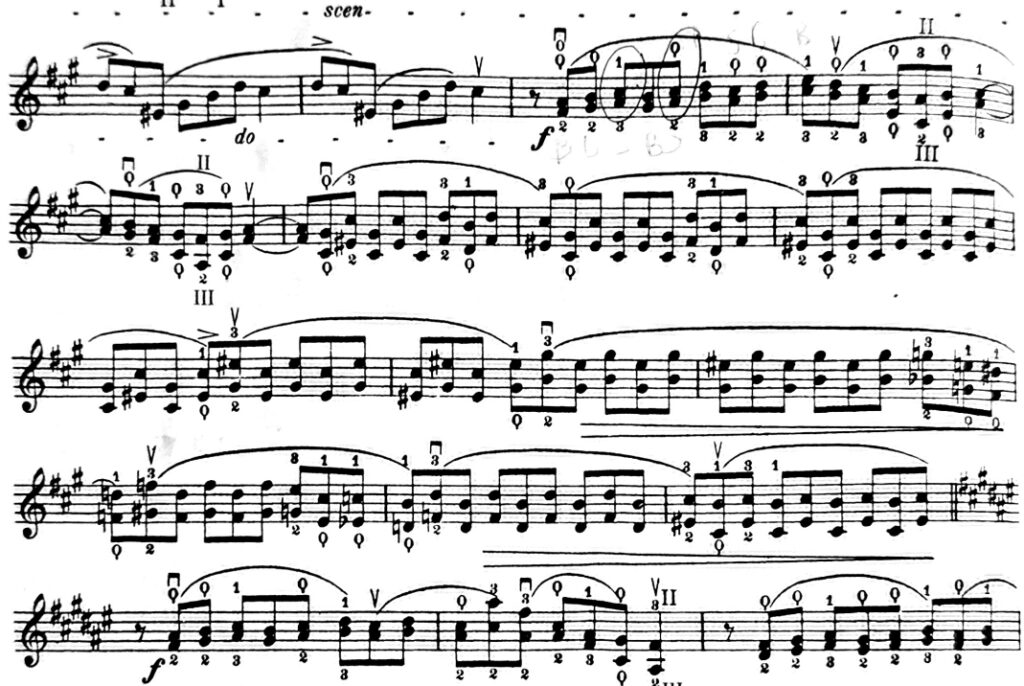
I know, right? But it’s better to encounter sliding thirds and skidding sixths in a piece you didn’t grow up in love with, only to get dashed against the rocks when you give it a go. But the thing I want you to notice is that this is a rich text: the intervals adjust in some way nearly every time you play them! I circled the C#Es because the first time it’s played with thumb and 2, the next time, with 1 and 3, which are radically different feelings in my hand. Thumb 2 feels like an old friend. 1 and 3, in this context is more like this:

It’s not my favorite shape in this register. These measures are absolutely strewn with this skill. Then he adds accidentals (who doesn’t love E sharp?) and alternates between sliding around and staying in place. And it goes on and ON.
High quality practice of this passage requires a lot of patience, because every time it goes wrong, that’s a rep that the brain latches onto as a possibility until you override it with a bunch of correct reps.
In my practice of this today, I spent about 10 minutes on the first measure of the double stops, simply playing the bottom note first, audiating the top note, then adding the top note before going to the next shape. Then, using only my left hand, I did a silent run of the measure about 10-15 times, just to get the order of operations correct. Those operations are:
- start on F#2, A thumb
- shift a whole step with both fingers to rest on G#2, B thumb
- stay in place, 3 is a half step above where it was for A2, C# thumb
- stay in place for the same G#2, B thumb
- shift a half step, bringing 2 from G# to A, but thumb moves a whole step from B onto C#
- stay in place, 2 moves up a whole step to B on 2 and thumb moves up a half step find D.
- … &c.
Now, I have a slightly different system for how I will actually turn this eventually, at some distant point in the future, into a less monstrous task, taught to me by Amit Peled. After finding the first shape, I see the next shape the hand shape in its entirety and only measure shifts with the lower note (usually; very occasionally the upper note offers more stability, but the orthodoxy is to secure the lower pitch first for all kinds of good reasons). But it doesn’t matter. To come up with those shapes, I have to do many passes of the method I listed above.
And even with that small sample size, it was too many shapes, too much for my body to make sense of. I kept finding myself asking, afresh, “Now, what was the trick to this shift?” and had to work it out all over again. Even though I had literally worked it out moments before. Writing all over the page didn’t help, either.
As a corollary to the TV practice post, this is the opposite of the cognitive load exercise I described there. Once I have this section under my fingers so I no longer need to read the music, I might introduce some attention splitting. But that is not recommended for the initial onboarding phase I’m talking about in today’s post. And I will be onboarding for at least a week, if you’re curious. I take extra time so I don’t injure myself and also won’t need to go back and retrace my steps after moving to the next phase too soon. The long road, taken once, is the short cut.
What I needed was a foothold. So I practiced the first two easier chords a few times, just making sure my technique was controlled and comfortable. Then I worked up the previous measure. Then I added the next chord, which took some time to get in tune, but it wasn’t conceptually challenging. The next one was. So that was my terminus for that practice session. I would go from the previous measure through the first thing I really struggled with. Over and over. Some might say it was more times than I should require, but I know what I need. Now firmly in midlife, I accept the more frequent memory lapses and competition for my attention. I do not enjoy them, but I am not about to pretend they don’t change my capabilities. It’s not all downside; I now feel more comfortable with playing pieces to my liking rather than in comparison (or competition) with someone else. But the key here is to know yourself, know your tendencies, and let them in. Examine them, have sympathy for them, and structure your practice to combat the ones that you know hold you back.
So to sum up, meticulous practice can still disappear on you if the task has too much going on. In this section, even just the first two measures of double stops have close to 2 dozen different things to measure, and that’s before looking at finer aspects of intonation and the certifiably insane bowing.
Tailor your practice of new notes to the steepness of the challenge contained within them. If you don’t have a good sense for where your limits are (because perhaps you feel like you only have limits at the moment) just assume that less is more, find a foothold: a note or notes that felt impossible when you sat down and becomes possible, if scruffy, after some work. Stay with that for today. If it’s largely intact when you sit down next time—your practice has not disappeared—then add the next one until it, too, shows up the next day. ‘Tis better to learn slowly and spend precious time than move too quickly and not learn at all.
I’m here if you have questions! Wishing you all an excellent week of practice.